About Woodlands Park School
Woodlands Park School is a primary school situated in the Waitakere Ranges of West Auckland. They have approximately 350 students, ranging from Years 1-6.
Prior to using StepsWeb, they identified that time was one of their main challenges. They had been using a structured literacy approach for four years, but found some students still needed individualised, specific instruction.
How the school came across StepsWeb
Before trialing StepsWeb with whole classes in 2024, Woodlands Park School had already been using StepsWeb for several years with small groups, but felt they weren't using it effectively.
The trial was implemented through a Resource Teacher: Learning and Behaviour (RTLB).
A more inclusive approach
In 2024, Woodlands Park School began a trial of StepsWeb through an RTLB, implementing the program as a whole-class approach across four classrooms - Years 3-4 and Years 5-6.
The educators at Woodlands Park School liked that StepsWeb adapts to each student's level and pace and that StepsWeb uses multisensory techniques to foster working, visual, and auditory memory, making it inclusive for all students. This makes StepsWeb suitable for more advanced students, while also providing necessary support for students with learning difficulties.
Woodlands Park School educators wanted to expand StepsWeb within their school to make it more inclusive. After seeing positive results from their trial in 2024, the educators convinced the Board to adopt StepsWeb for all students in Years 3-6, spanning across eight classrooms in total. The Results section shows student outcomes from the eight classrooms in 2025.
Woodlands Park School are an example of how StepsWeb can be successfully implemented as a school-wide approach. By encouraging students to meet Weekly Goals, and complete their StepsWeb work, they have seen impressive literacy progress across a wide range of abilities.
"One of the program's strengths is that it is an online platform that adapts to students' levels and pace. This personalised approach links to our structured literacy approach, it aligns with the new English curriculum and supports comprehension development."
-Tania C. Learning Support Coordinator
Extra support for Tier 4 students
Teacher Aides (TA) worked with students who were identified as tier 4 (high need learners). Learn more about the 4-Tier Model Response to Intervention on our Remedial Learners webpage.
"Children working in groups with a TA are talking about how their confidence is growing and that they feel their spelling is improving."
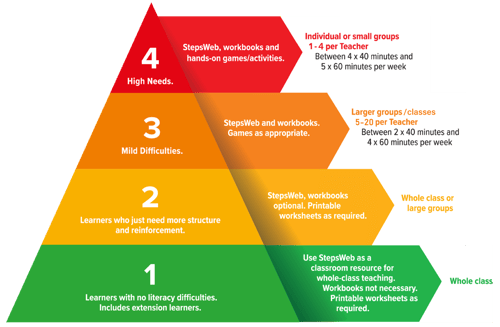
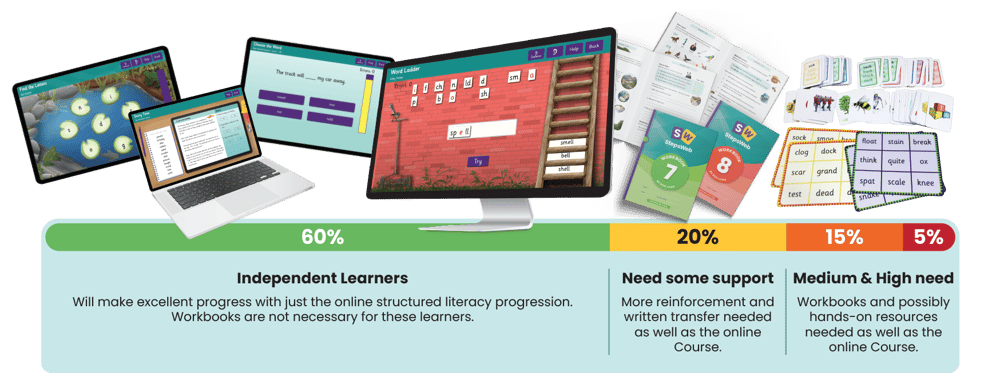
StepsWeb recommends that students identified as being tier 3 and tier 4 use the workbooks and potentially hands-on resources. This is to provide more reinforcement alongside the online program, and to consolidate their learning.
Encouraging Weekly Goal completion
The educators at Woodlands Park School found keeping up motivation for students to complete their Weekly Goals was a challenge. They overcame this by:
Learn more about Weekly Goals in the Results sections of this case study - they played a significant role in improving literacy results.
StepsWeb reports were used to show gaps and share achievements
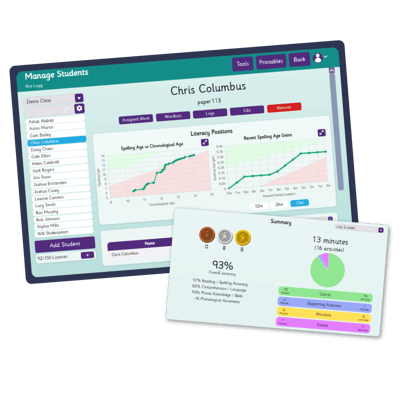
Educators used the reporting tools within StepsWeb to keep track of their students' progress and identify any students falling through the gaps. Teachers enjoyed showing students their individual progress graphs so they can see how much they've improved.
"The reporting immediately shows any gaps or areas that require extra support. The students can follow their learning and accomplishments."
Improved confidence
The Woodlands Park educators reported seeing significant improvement in spelling and reading confidence.
"The programme covered things like months of the year, which some children still didn't know until working through the programme."
Students are engaged
The students at Woodlands Park School are engaged in their StepsWeb learning, with most either achieving their Weekly Goals, or going a long way towards them.
"Having the medals makes it motivating, but we also make it an expectation that they are working on StepsWeb in class."
Improvements in writing
Teachers have seen how using StepsWeb is crossing over into their writing and reading abilities.
“I have seen a huge confidence shift in the children's writing books. Children love StepsWeb and like to complete this before and after school too!”
Reducing teacher workload
With StepsWeb having the capability to be an independent activity for the majority of students, the Woodlands Park educators were able to spend more time with groups of students who need extending or extra support. The educators felt assured their students were receiving tailored reinforcement, each at their own level and pace.
Compatibility with other programs
The educators reported that StepsWeb was able to link to other resources and programs being used within the school. StepsWeb enabled educators to supplement their teaching of specific areas and topics by assigning built-in wordlists or creating their own custom wordlists.
Note: The above quotes were all provided by Tania C. - the Learning and Support Coordinator at Woodlands Park School.
Summary
Across all of the charts shown below, a clear pattern emerges: students who completed more StepsWeb activities tended to make greater progress in their spelling age.
In particular, students who consistently met or exceeded their Weekly Goals generally showed the strongest literacy gains. While individual progress varied, the results strongly suggest that regular completion of Weekly Goals plays an important role in accelerating literacy development.
The graphs below provide a snapshot of student results from 2025. These students used StepsWeb over a 9 month period.
This includes results from eight classrooms of Year 3-6 students. We received data from 163 students in total, and have included results from 119 of these students below. 44 students were excluded as they only had one test result, thus no spelling age comparison could be made. We've included four graphs:
Weekly Goals are automatically assigned by StepsWeb based on each student’s spelling age. All students in this study had a Weekly Goal of 20 activities per week.
Students who are behind their expected level are given more activities per week to help them catch up, while students working at the expected level are given fewer activities to maintain progress.
Learn more about what we mean by 'Weekly Goals' on our Support Site. We've also included a detailed explanation of why Weekly Goals are important at the bottom of the Results section.
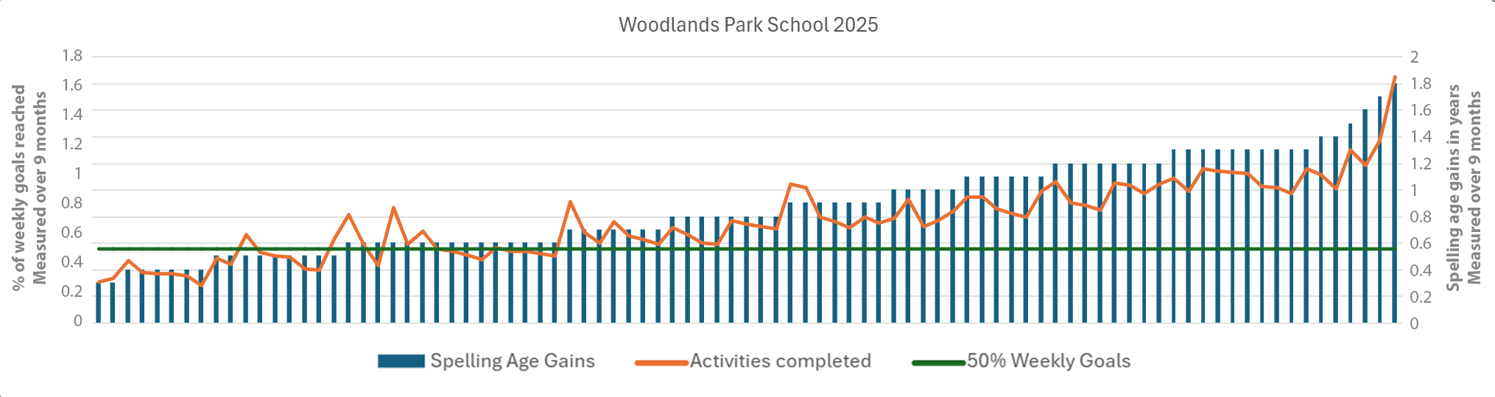
The above graph shows the Woodlands Park students' literacy gains, and comparing this against activities completed (Weekly Goals).
The above results suggest there is a correlation between Weekly Goal completion and literacy progress. Generally speaking, students who met at least half of their Weekly Goals, made an average of 12 months spelling age gain after 9 months of using StepsWeb. We recommend teachers aim to complete as many of the Weekly Goals as possible to see good progress.
Students who completed all their Weekly Goals and more saw an average of 16 months spelling age gain after 9 months of StepsWeb. Having students complete all their Weekly Goals over the school year is an incredible feat, especially after you account for student sicknesses and absences over a long period of time.
This demonstrates that the more Weekly Goals your students complete, the higher the literacy gains you can expect to see.
Read the Weekly Goal explanation at the bottom of this section to learn more about what they are and why they are important.
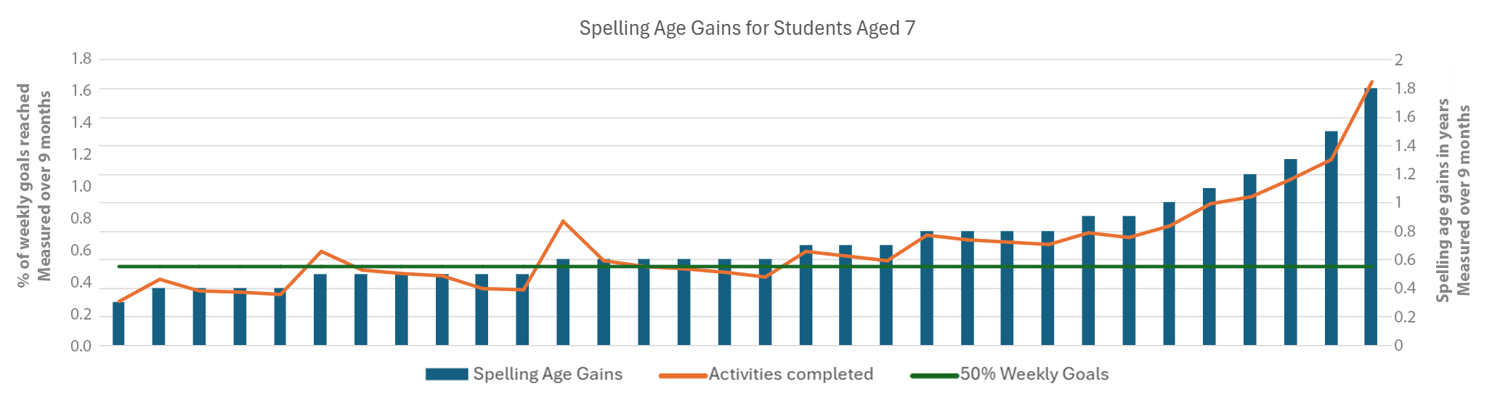
The above chart shows progress from students who were 7 years-old when they entered StepsWeb at the beginning of 2025.
Students from this age group who completed at least half their Weekly Goals had 10 months spelling age gain on average.
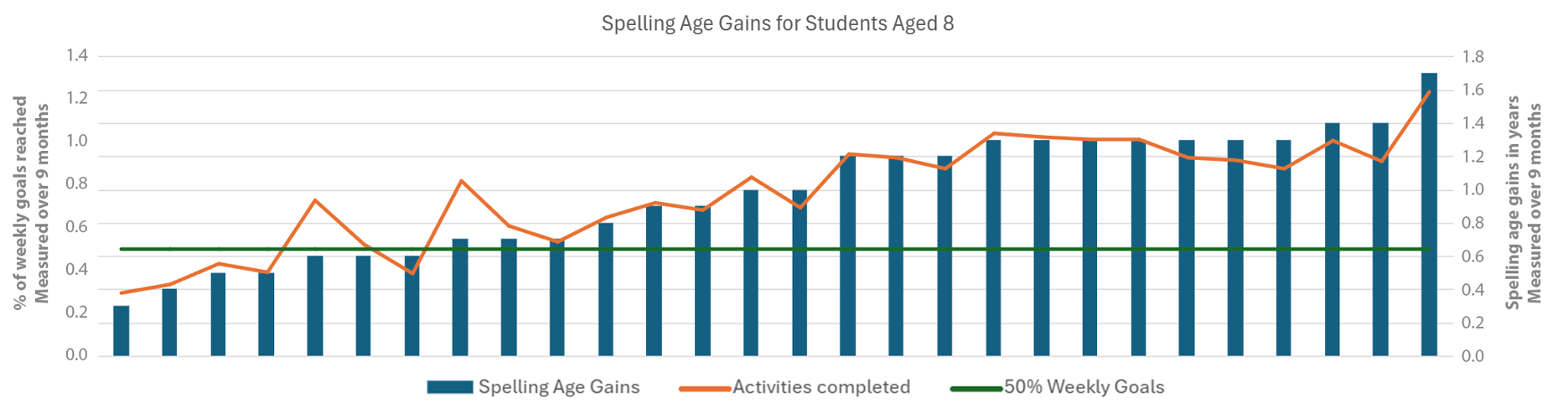
The above chart shows progress from students 8 years-old when they entered StepsWeb at the beginning of 2025.
Students from this age group who completed at least half their Weekly Goals had 13 months spelling age gain on average.
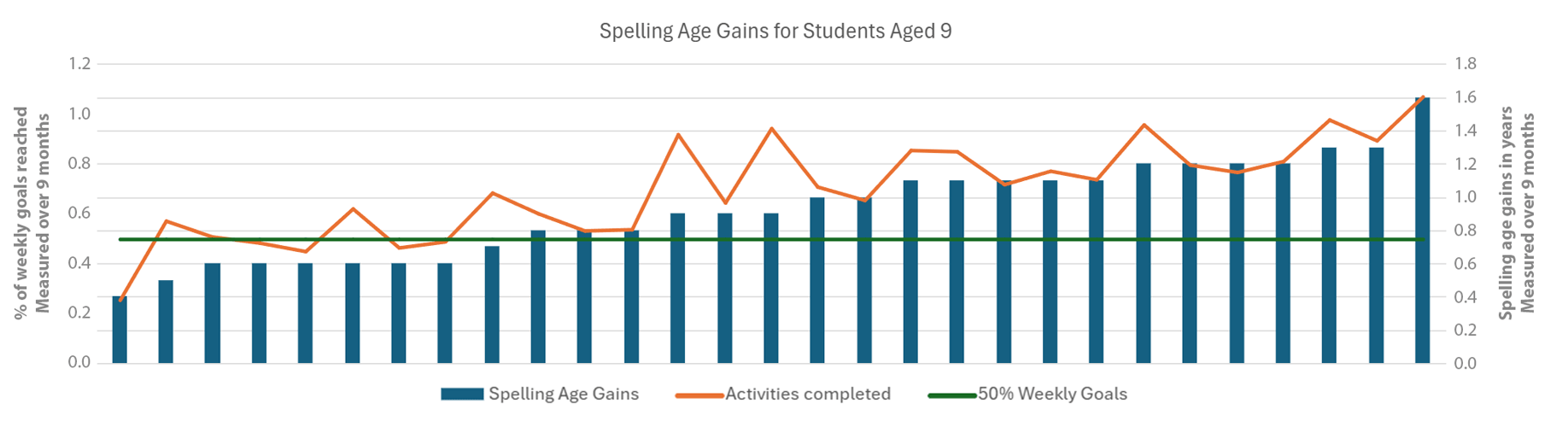
The above chart shows progress from students who were 9 years-old when they entered StepsWeb at the beginning of 2025.
Students from this age group who completed at least half their Weekly Goals had 13 months spelling age gain on average.
What are Weekly Goals?
Weekly Goals are a feature of StepsWeb designed to help struggling students reach equality between their Spelling Age (SA) and Chronological Age (CA), and to help the rest of your students keep their SA in check with their CA.
StepsWeb automatically assigns a Weekly Goal to each student. The Weekly Goal is determined by how the student has been placed by the initial Spelling Placement Test.
If your student tests with a SA of one year less than their CA, they will automatically be given a Weekly Goal of 20 StepsWeb activities per week. This is the number of online activities, when successfully completed with a silver medal, that will bring their SA one year closer to their CA, over the period of one year. Once your students have a SA and CA that are the same, the program reverts to 10 activities per week. This is the number of activities that will keep their SA in line with their CA.
In more simple terms, if the program has identified a student to be behind where they should be, StepsWeb will recommend they complete more activities to effectively catch them up to their peers.
There are multiple ways to track your students' Weekly Goal progress. We've included more information on tracking Weekly Goals in the Considerations and Limitations section of this case study. You can also find out more from our Support Site article on Weekly Goals.
Advice for keeping track of Weekly Goals
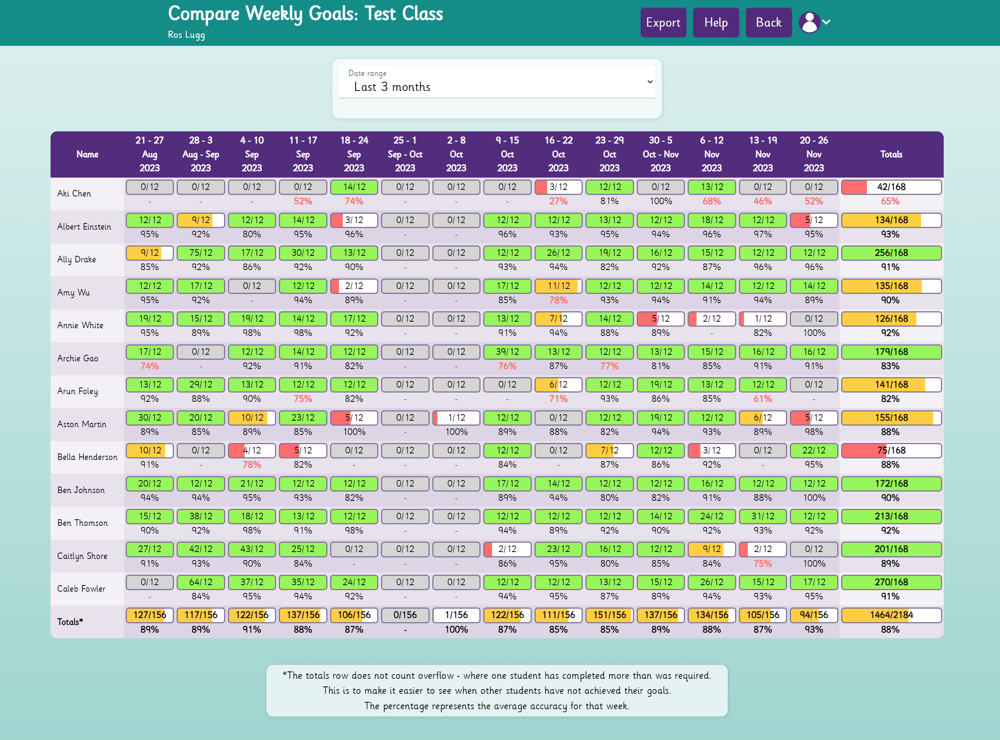
StepsWeb has multiple ways of monitoring Weekly Goal achievement.
Teachers with Educator Logins are emailed students' Weekly Goal progress on a weekly basis. By having educators favourite their class they will receive progress reports of their specific students.
Additionally, StepsWeb contains a report that shows educators at a glance their students' progress towards Weekly Goal completion.
Educators and parents should encourage their students to complete as many Weekly Goals as possible, as more activities completed typically correlate with higher literacy gains. Woodlands Park School motivated students to complete their StepsWeb work through running class competitions, spot prizes, and communication with students' families.
Learn more about Weekly Goals on our Support Site.
The StepsWeb Course
When we refer to the 'StepsWeb Course,' we are referring to the structured, cumulative, built-in progression on StepsWeb which every student is placed onto as a result of their initial Spelling Placement Test.
The StepsWeb Course follows a progression which is research-based and aligns with Structured Literacy and the Science of Reading principles. A major benefit of StepsWeb is it will automatically assign activities to students at their own level.
StepsWeb Course Scope & Sequence
Woodlands Park School primarily uses the StepsWeb Course for their students, and have consistently seen excellent results. Please feel free to contact us if you would like more guidance on using the Course.
Using StepsWeb in small groups vs whole-class
The StepsWeb Course has been designed to look the same throughout, so students working at a lower level feel no different to their peers who are working at a more advanced level of literacy. StepsWeb will automatically provide more reinforcement to students who have been identified as struggling from the initial Spelling Placement Test, allowing them to catch up through more practice of core skills.
Using StepsWeb with small groups will likely see significant gains for those students, however using the program in this way also comes with limitations.
Recent research into StepsWeb usage suggests that using the program with small groups can cause students to feel self-conscious due to segregation from their peers. Using StepsWeb with the whole-class reduces this from happening, and all students, including both struggling and extension learners see progress. StepsWeb adapts to each learner, meaning every student works at their own level and pace, making it an ideal resource that caters to both high need and extension learners.
We also recommend struggling students use the workbooks alongside the online Course to provide further reinforcement and to consolidate the skills being practiced on StepsWeb. While workbooks would likely benefit all students, the majority of learners will progress just fine on the online Course alone. Learn more about StepsWeb Workbooks.
Woodlands Park School is a prime example of the impact StepsWeb can have when transitioning from small groups to whole-school. While educators were initially met with some resistance from students who had previously used the program as a remediation tool, this subsided once the students realised everyone else was using StepsWeb too.
Woodlands Park School went on to see significant improvement across students of all abilities and levels of literacy.
If you would like further advice on how to transition from using StepsWeb with small groups to whole classes, please feel free to reach out.
Woodlands Park School’s experience shows how StepsWeb can be successfully implemented as part of a wider structured literacy approach. After initially using the program with small groups, the school trialled StepsWeb across several classrooms before expanding it to all Year 3–6 students.
By encouraging students to work consistently towards their Weekly Goals, educators were able to support learners at a wide range of ability levels while maintaining a manageable workload for teachers. The adaptive nature of the program meant that students could work independently at their own pace, while teachers and teacher aides provided additional support where needed.
Over the course of nine months, students demonstrated strong gains in spelling age, particularly those who regularly met their Weekly Goals.
Alongside these measurable improvements, educators also reported increased confidence, engagement, and motivation among students.
Woodlands Park School demonstrates how StepsWeb can complement structured literacy teaching and support inclusive learning across a whole classroom. Their experience highlights the importance of consistent use, clear expectations, and ongoing monitoring of student progress to achieve strong literacy outcomes.