![Auckland Uni logo blue]](https://www.stepsweb.com/hs-fs/hubfs/Auckland%20Uni%20logo%20blue%5D.png?width=226&height=223&name=Auckland%20Uni%20logo%20blue%5D.png)
The Learning Staircase collaborated with researchers from the University of Auckland (UoA) to validate the Visual Recognition Test as a tool for identifying learners who are likely to struggle with literacy.
StepsWeb includes two online tests, an initial Spelling Placement Test and a Visual Recognition Test, which measures how quickly (in milliseconds) a learner can recognise a word. This test is designed to measure word recognition and set the speed for the Word Flash activity in StepsWeb, which is designed to develop recognition speed.
Impairments in visual recognition of lower-level cues are often associated with reading difficulties, the visual-recognition task StepsWeb incorporates may also be used to identify children who are likely to experience difficulties with literacy.
The Learning Staircase reports that learners with dyslexia and other learning disabilities tend to be slower to recognise known words when flashed at high speeds.
UoA therefore assessed the relation between performance of children aged between 5 and 8.9 years on visual-recognition tasks used in StepsWeb.
Generally, the time needed to identify the visual cues in all tasks decreased with age, and was shorter for learners whose literacy skills were of the least concern to their teachers relative to learners whose literacy skills were of the most concern.
We therefore suggest that such a task may provide a viable method of identifying learners who may have difficulty reading, which has the potential to be administered before learners are taught to read.
Exploring the relation between visual recognition speed, teacher literacy assessment and age.
Supporting research in this field shows that instant visual recognition of words happens in a fraction of a second, whereas conscious decoding is a slower, labour-intensive process. Some studies have indicated that being able to recognise a word in around 150ms or faster is a clear indicator that the reader is using the Visual Word Form Area of the brain.
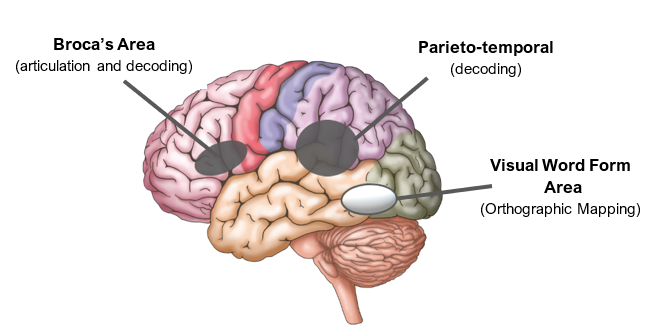
In 2015, the StepsWeb development team designed a prototype test which enables a teacher to track a learner’s progress and identify when they transition to using the Visual Word Form Area of the brain for instant visual recognition.
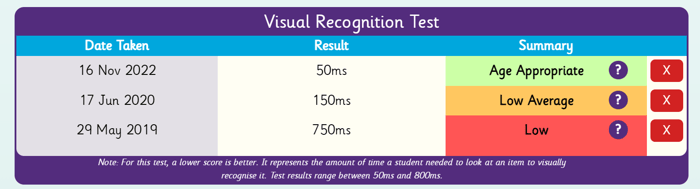
In 2016, the prototype test was used in a number of schools. This proved to be successful at identifying learners with difficulties. One interesting prototype test was carried out in a new entrant class at Fernside Primary School. All learners were aged 5 or 6. Some were emergent readers, but others were pre-readers.
The University of Auckland (UoA) analysed the data from these trials and advised on further development to ensure that the test was statistically valid.
Their report was published in January 2017 and their recommendations were implemented into the Visual Recognition Test now on StepsWeb.
977 children (484 female, 493 male) from New Zealand schools participated. Participants were aged 5 to 8.9 years.
Participants’ teachers were asked to evaluate whether or not each student might be dyslexic (either yes or no), and to rate their level of concern about each student’s literacy. A rating of 1 indicated no concern, 2 indicated some concern, and 3 indicated major concern.
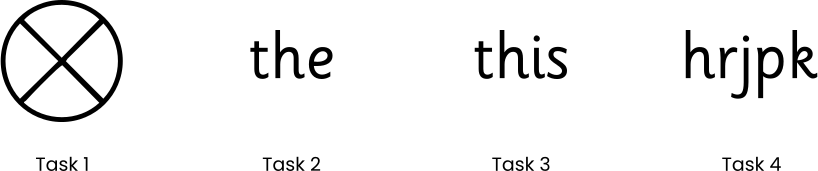
Four computer-based tests (Tasks) were used, each differing in the type of visual cue presented: Complex shapes (Task 1), shorter words (Task 2), longer words (Task 3), and non-word combinations of letters (Task 4).
Examples of a visual cue from each task:
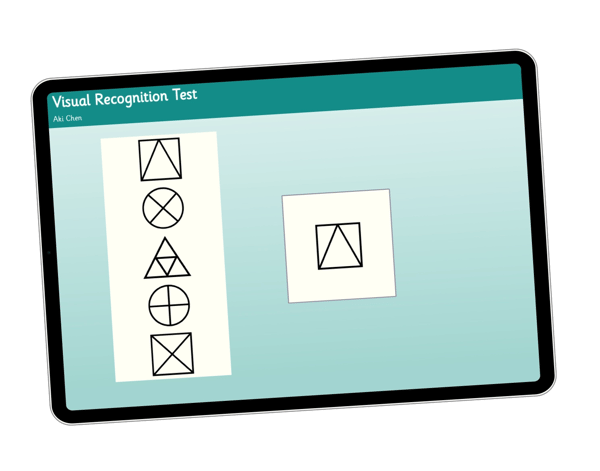
In each Task, a cue was presented briefly on the computer screen. Once the sample cue disappeared, participants were required to select the cue that had been presented from a range of five similar options. These options remained visible at all times, and their order and position on the screen was fixed.
The test assessed how children aged between 5 and 8.9 years performed on visual recognition tests using shape, word, and non-word cues. Gender and Decile were included as part of the student information but has no effect on results, suggesting that the test is appropriate for use within any school and a wide range of students.
The study found that indicators linked with reading ability may be present even in the very early stages of learning to read.
Average score for each age group (where age is calculated in years) for each Task.
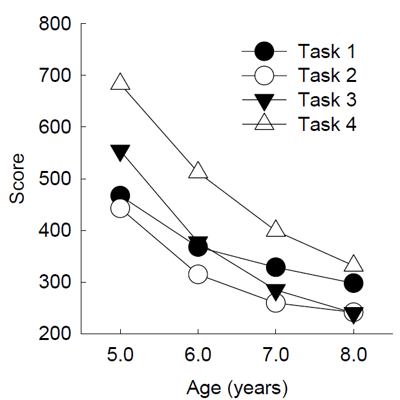
The above chart shows a clear pattern: younger children require more time to process what they saw than older children (across all tasks). Students also generally needed longer viewing times to process the more complex tasks (Tasks 3 and 4) than on simpler tasks (Tasks 1 and 2).
Frequency of scores in Task 3, for each age group.
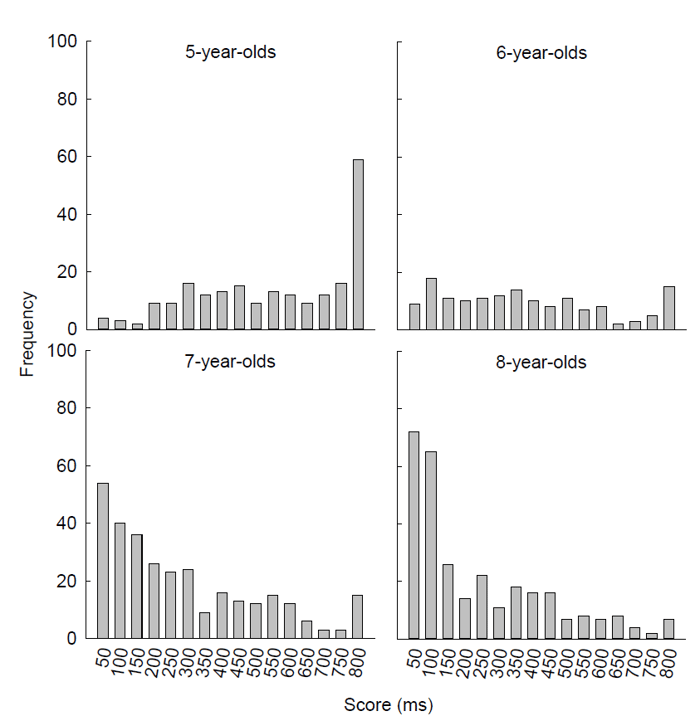
The results from Task 3 demonstrates how students' visual recognition speed generally improves as they get older.
Score on each Task, averaged across students with the same teacher rating.
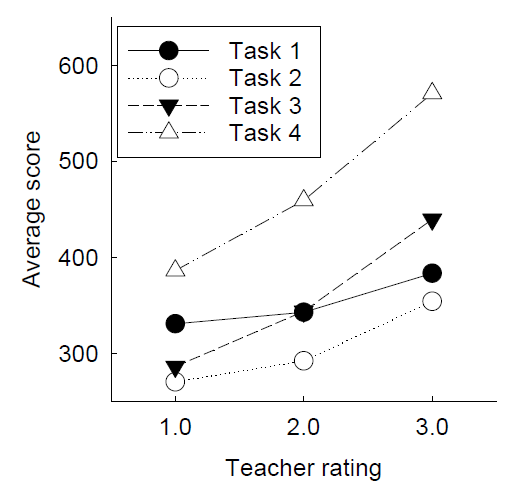
Teachers were asked to rate their level of concern about each student’s literacy. A rating of 1 indicated no concern, 2 indicated some concern, and 3 indicated major concern.
Overall, students whose teachers were more concerned about their literacy level tended to need more time to recognise the visual cues (which means they scored poorer results on these visual recognition tasks).
This link was stronger in Tasks 3 and 4 than in Tasks 1 and 2. So, assuming the teacher ratings are accurate, Tasks 3 and 4, which use longer words and non-word combinations of letters, were the best at showing differences in literacy ability.
The results are consistent with findings that indicate individuals with reading difficulties have trouble with rapid-exposure visual-recognition tasks; the method and design of the test appear to be appropriate for identifying visual perception skills used in reading.
For a more in-depth analysis of the results, we recommend reading the full academic report produced by UoA.
The UoA evaluation provided helpful guidance for how the Visual Recognition Test should be used within StepsWeb.
Adjustments based on student age
The research found that Task 3 and 4 were most strongly linked to teacher literacy concern, meaning they were better indicators of literacy difficulty than Task 1 and 2. However, non-word visual cues (Task 4) were often too difficult for five-year-olds to recognise, even at the longest time.
Therefore, UoA researchers recommended that the test be adjusted so that Task 4 does not appear for five-year-olds. Based on their recommendation, this change has since been implemented into the StepsWeb Visual Recognition Test, so Task 4 does not appear for students 6 years and below.
Prioritise Task 3 for setting starting speed
Across age groups, Task 3 (longer words) was generally achievable while still being sensitive to literacy differences. It also correlated with teacher concern in a similar way to Task 4, without being as developmentally difficult for younger learners.
The StepsWeb development team implemented the advice given by the UoA researchers: to use Task 3 within the Visual Recognition Test to set the speed for the Word Flash activity, as it supports a good balance of accessibility and accuracy.
Allow for 'warm-up'
The report also notes that results might be affected by students "getting used to" the tasks. Because of that, it may help to keep Tasks 1 and 2 as warm-up tasks.
Interpret results carefully
The report emphasises that visual recognition performance links to literacy ability, but it is only one component of reading (visual processing), rather than the full range of literacy skills.
It's important to keep in mind that visual recognition scores should be used to personalise speed within the Word Flash activity in StepsWeb, and as a helpful indicator, but not as a stand-alone measure of reading difficulty.
Researchers tested how well children aged 5 to 8.9 years could recognise shapes, words, and made-up “non-words” when shown very briefly on a screen. The test adjusted the display time until each child reached about 80% accuracy.
What they found
Link to literacy ability
No bias by school decile or gender
Results did not differ by school decile or gender, suggesting the test is suitable for a wide range of learners and schools.
The bottom line
UoA researchers stated that the Visual Recognition Test may provide a viable method of identifying learners who may have difficulty reading, which has potential to be administered before learners are taught to read.
The report emphasises that even though there was a link between visual recognition speed and literacy concern, results should be interpreted carefully. This test measures one piece of literacy, not the full range of literacy and reading skills.
Read the full academic report produced by the University of Auckland researchers.
Visit our Visual Recognition Test page to learn more about the test this report is based on.
Using the test in StepsWeb
It's important to keep in mind that the Word Flash activity will appear organically in the StepsWeb Course. This activity monitors visual recognition speed, so as long as your students make their way through the online structured literacy Course, StepsWeb will continually monitor their visual recognition progress, regardless of whether you have set the test or not.
You can see your students' Word Flash speed by going to their Learner Information in Manage Students - under 'Word Flash Delay'.
Please feel free to contact us if you require further assistance with either administering the Visual Recognition Test or analysing results.
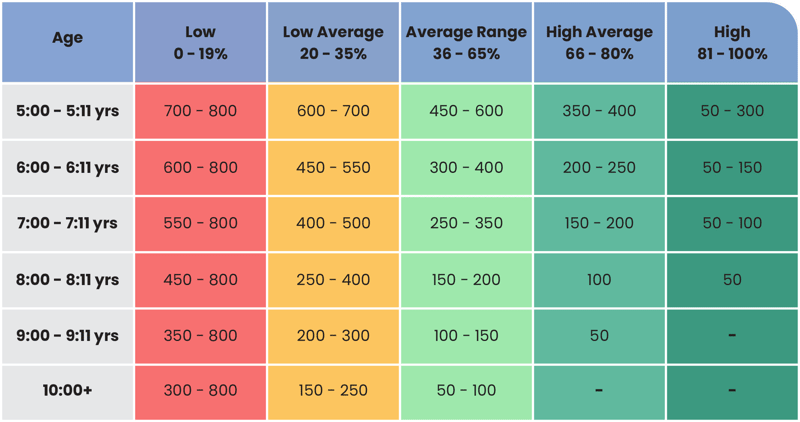
The chart below offers guidance on what would be considered an average time for a variety of ages.
Learn more about how literacy develops with webinars by literacy specialist and founder of StepsWeb, Ros Lugg:
Literacy Development - Key Phases and Neurological Implications.